.png)
As a business grows beyond its early stages, financial decisions become more complex. Cash flow becomes harder to predict, margins need to be optimized, and strategic planning requires more than basic bookkeeping or tax support.
That’s when companies begin exploring the value of a Small Business CFO—a financial leader who provides clarity, discipline, and direction.
While many early-stage companies don’t need a full-time CFO, they do need CFO-level thinking to scale successfully. That’s where fractional, virtual, or project-based CFO services come in.
A Small Business CFO provides high-level financial leadership tailored to the needs of growing businesses. Unlike bookkeepers or accountants who focus on tracking transactions, a CFO takes a strategic view—guiding decisions that impact profitability, growth, and long-term sustainability.
Typical responsibilities include:
In short: a Small Business CFO helps founders see the bigger picture.
Not necessarily.
Most small businesses (and many mid-sized ones) don’t yet need—or can’t justify—a full-time CFO salary, which often exceeds $200,000–$350,000 per year plus benefits.
Instead, they benefit from:
These models provide the expertise without the full-time cost.
There are specific signs that a business is ready for CFO-level expertise:
If you’re unsure how much runway you have—or how to stabilize cash flow—a CFO brings structure and forecasting discipline.
Scaling requires stronger systems, better reporting, and clear financial roadmaps.
A CFO analyzes margins, pricing, and cost structure to strengthen profitability.
Clean, consistent financials build trust with external stakeholders.
If you're spending more time in spreadsheets than strategy, it’s time to level up.
A CFO transforms financial data into real strategic insight.
This is the kind of leadership that turns a growing business into a scalable company.
Many businesses confuse these roles. Here’s a simple comparison:
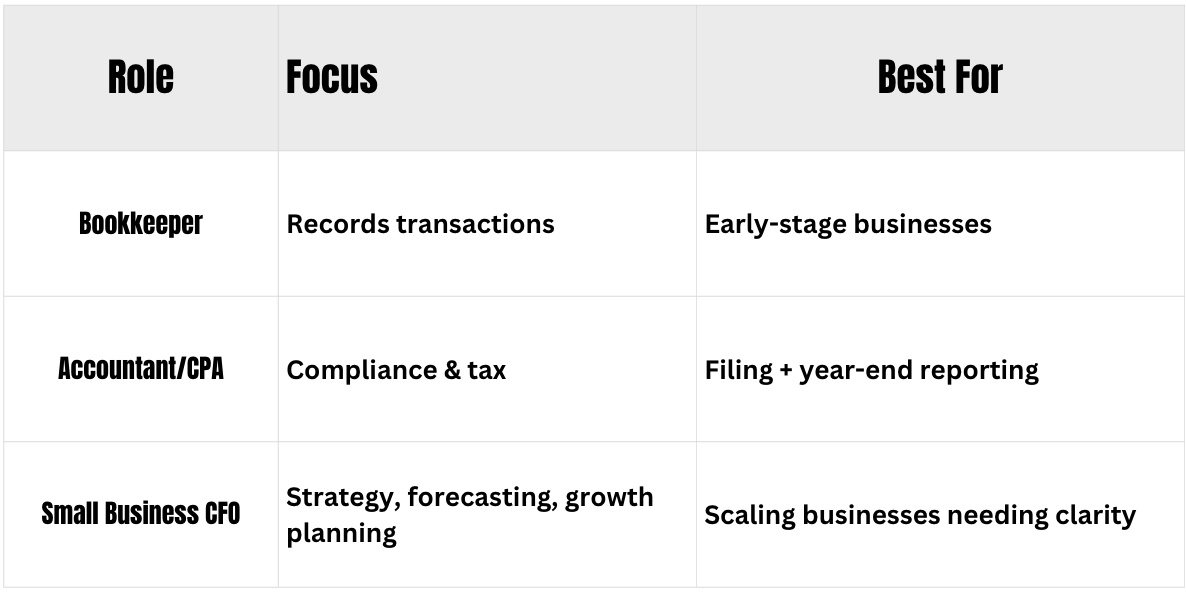
A CFO doesn’t replace your accountant—they work above them to guide better decisions.
A Small Business CFO provides clarity, insight, and financial leadership exactly when growing companies need it most. Whether part-time, fractional, or virtual, CFO-level expertise helps founders make informed decisions, prepare for growth, and build a business designed to scale.
If your company is moving beyond early operations and needs more strategic financial guidance, a small business CFO may be the catalyst that helps you move from busy to scalable.